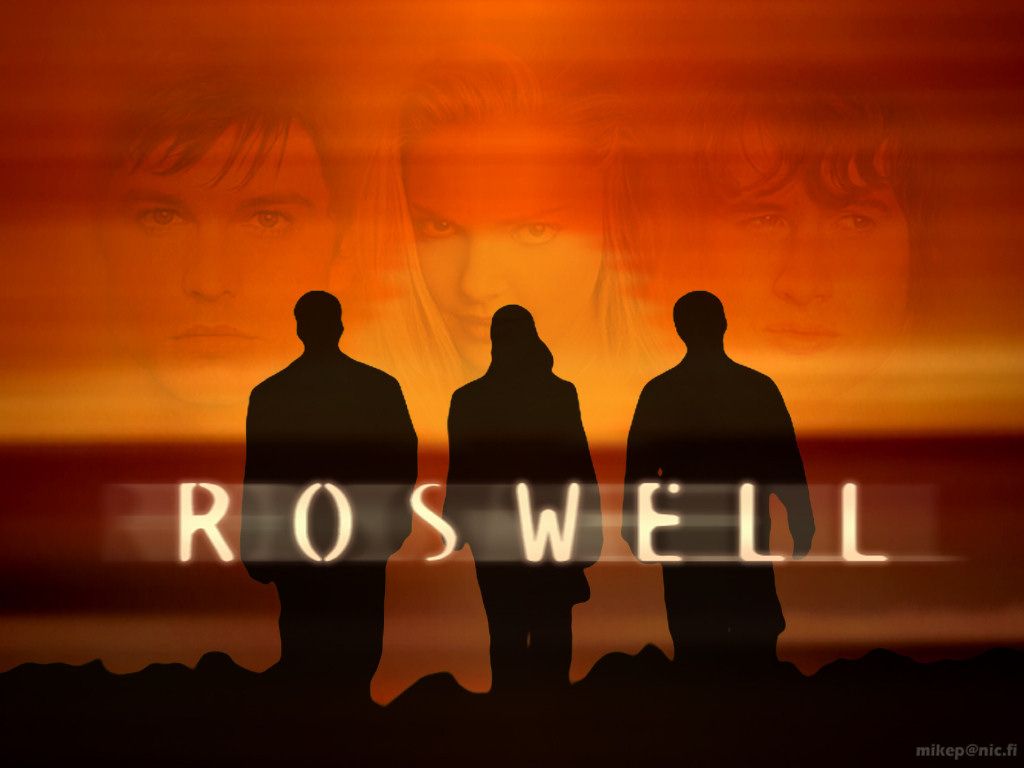
Deep Dive · Roswell (1999)
The Crashdown
Café Chronicles
How a Diner Became the Heart of Roswell
It wasn’t just where Liz worked. It was where the whole story lived.
Every great TV show has a place that anchors it. Central Perk in Friends. The Peach Pit in Beverly Hills, 90210. The diner in Gilmore Girls. These aren’t just sets — they’re emotional hubs, the places where the characters keep returning because the show keeps returning to its own heart.
In Roswell, that place is the Crashdown Café.
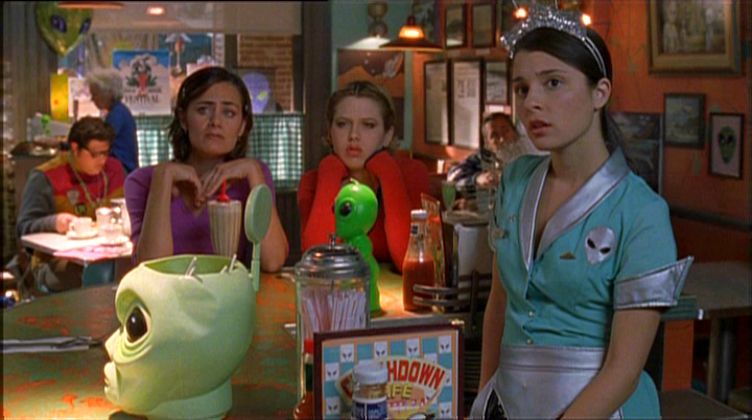
A kitschy alien-themed diner on the main drag of Roswell, New Mexico, complete with antennae headbands and turquoise uniforms, the Crashdown is so much more than a backdrop. It’s the place where the entire mythology of the show begins, where secrets collide with normalcy, and where human and alien lives become permanently, irrevocably tangled.

The iconic Crashdown Café branding

The neon-lit storefront — Roswell, NM
Where It All Begins
The Crashdown doesn’t just appear in the pilot — it is the pilot. When a fight breaks out and Liz Parker is shot, it’s Max Evans who crosses the diner floor to save her, pressing his hand to her stomach and pulling her back from the edge of death. In doing so, he exposes himself, shatters the secret he’s kept for years, and sets every single event of the series into motion.
Think about that for a moment. Without the Crashdown, there is no show. The diner isn’t just a setting — it’s a catalyst. It’s the place where the boundary between the alien and the human gets crossed for the first time, and once crossed, it can never be put back.
The choice to set this moment in a diner is quietly brilliant. Diners are inherently democratic, egalitarian spaces. Anyone can walk in. Anyone can sit down. They belong to everyone and no one. By making the Crashdown the site of the show’s inciting incident, the writers were saying something about what this story would be: ordinary people and extraordinary secrets, sharing the same booths, the same pie, the same fluorescent light.
Without the Crashdown, there is no show. It’s not just a setting — it’s the place where the boundary between human and alien is crossed for the first time.

The alien mural booths — heart of the café

The front doors — always open, never safe
A Space That Contains Multitudes
What makes the Crashdown so effective as a storytelling device is how many different functions it serves, often simultaneously. It’s a place of work — Liz and Maria spend countless hours in those turquoise uniforms, slinging alien-themed burgers and navigating the mundane indignities of the service industry. It’s a social hub where the gang congregates, plans, argues, and occasionally laughs.
But it’s also a place of danger. The Crashdown is the scene of the shooting that starts everything. It’s the diner outsiders walk into looking for answers about the aliens. It’s surveilled, scrutinized, and repeatedly at the center of whatever threat is bearing down on our characters in any given season.
This tension — between the Crashdown as safe haven and the Crashdown as ground zero — gives the location its dramatic power. Characters can never fully relax there. The warmth of the place is real, but so is its volatility. Every scene set in the Crashdown carries a low hum of potential danger beneath the comfort, and that duality mirrors the show’s central theme: the impossibility of truly hiding who you are.

Behind the pass — where secrets leaked through

RosellOracle’s detailed kitchen layout
The Aesthetic Genius of the Alien Theme
It would be easy to overlook the diner’s alien-kitsch aesthetic as mere set dressing — a fun nod to Roswell’s real-life reputation as a UFO town. But the design of the Crashdown is doing something much more pointed than that.
Here is a diner that has built its entire brand around the idea of alien visitors. Its menu items have names like the “Alien Blast” and the “Men in Blackberry Pie.” The staff wear little antennae. The walls are covered in little green men. The whole place is a loving, commercial embrace of the very thing Max, Michael, and Isabel are desperately trying to hide.
The irony is delicious and entirely intentional. The aliens at the center of this story spend their lives hiding in plain sight — and they spend much of that time literally inside a building that celebrates their existence. Every time Max slides into a booth at the Crashdown, he’s sitting inside a monument to his own secret. It’s camouflage through visibility, concealment through spectacle. And it gives the show a layer of wit that keeps the premise from ever feeling too heavy.

Complete Crashdown Café layout — dining room, kitchen, employee room & outside area · RosellOracle
Liz’s World, Everyone’s Home
The Crashdown is fundamentally Liz Parker’s territory. Her family owns it. She works there. Her bedroom is literally above it — the rooftop outside her window is another iconic location in the show’s geography. The diner is, in the most literal sense, her home.
This matters because it establishes a power dynamic that the show often subverts. Liz is the human at the center of an alien story. She doesn’t have powers. She can’t heal. She can’t mindwarp or move objects. But she owns the room. She knows every booth, every order, every regular. In the Crashdown, she has a competence and an authority that the alien characters, for all their extraordinary abilities, simply don’t.
That grounding is what makes Liz such a compelling protagonist and what makes the Crashdown such a perfect home base for the show. It reminds us, in every scene set there, that this is ultimately a story told from a human point of view — that for all the sci-fi grandeur, we’re watching it through the eyes of a girl who just wanted to get through her shift.
The Crashdown reminds us that for all the sci-fi grandeur, we’re watching the story through the eyes of a girl who just wanted to get through her shift.

The Crashdown’s alien-themed menu alongside Liz’s iconic turquoise uniform
More Than a Set
Twenty-five years on, the Crashdown Café endures as one of the most memorable locations in teen TV history. Fans still cosplay the turquoise uniform. The antennae headband has become shorthand for the show itself. And the image of Liz behind that counter — notebook in hand, gaze slightly distant, always thinking — remains the defining visual of Roswell.
Great TV locations are containers. They hold the show’s memories — its pivotal scenes, its emotional peak moments, the lines of dialogue that fans still quote decades later. The Crashdown holds more of Roswell‘s memory than any other place in the series. It’s where the story was born, where it grew, and where, in quiet moments between the drama, the characters were simply allowed to be young and human and alive.
That’s what a good diner does. And the Crashdown was a great one.
What’s your favourite Crashdown moment? The pilot? A late-night booth conversation? Drop it in the comments — some TV locations never leave you.
Roswell · 1999