// TRANSMISSION — SUBJECT ANALYSIS — SEASON 1–3 ARCHIVE
Sheriff Valenti’s Journey:
From Antagonist to Unlikely Ally
[ ROSWELL, NEW MEXICO — DECLASSIFIED PERSONNEL FILE ]
The Shadow of His Father’s Obsession
Long before Max Evans healed Liz Parker in the Crashdown Café, the mythology of Roswell was already etched into the Valenti bloodline. James Valenti Sr. didn’t arrive at his suspicions through cold procedure — he inherited them. His own father, Sheriff Jim Valenti Senior, had spent decades chasing whispers of alien life, ultimately losing his career and reputation to the obsession. The younger Valenti bore that scar silently, walking the same corridors of power while desperately trying to distinguish himself from a man the town called unhinged.
What made Valenti’s opening arc so cinematically rich in the WB series Roswell (1999–2002) was precisely this inherited wound. He wasn’t a villain for the sake of villainy. He was a man using institutional authority as a bulwark against becoming his father — and yet, in doing so, he was becoming exactly that. Every interrogation of a teenage alien-hybrid. Every cold glance at Max and Isabel Evans. Every shadow he cast across Liz Parker’s life was the shadow of a man fighting his own reflection.
“He didn’t pursue the truth out of malice — he pursued it because the truth had already destroyed everything he loved, and he needed to know if the destruction was worth it.”
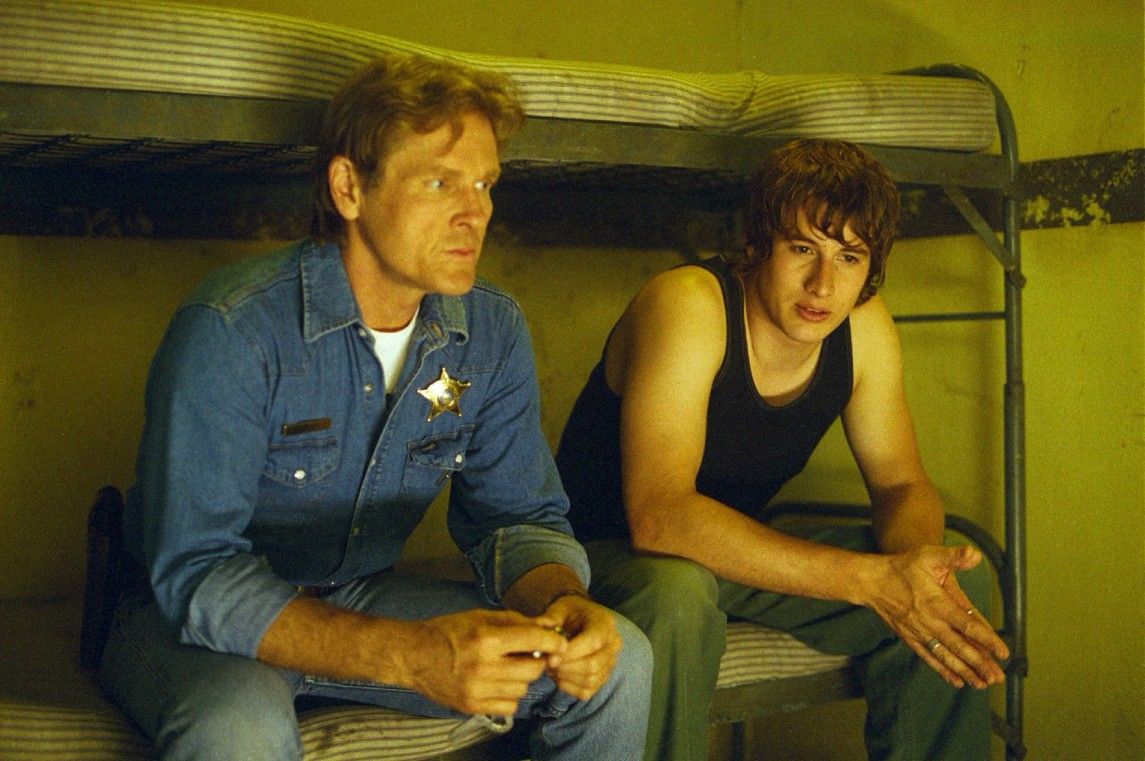
Actor William Sadler brought an uncomfortable authenticity to Valenti — a practiced stillness that communicated deep inner conflict without ever telegraphing it too broadly. His eyes carried the kind of exhaustion that only comes from years of watching something you believe in get dismantled by the people around you. Valenti believed. He had always believed. And that belief, rather than making him sympathetic from the start, made him dangerous.


The Mechanisms of Antagonism
In the first season, Valenti functions as a structural antagonist in the most classical sense: he is the force that threatens to unmask the protagonists and shatter their precarious lives. Every time Max, Isabel, Michael, or Tess moved freely through Roswell’s sun-bleached streets, Valenti was the reminder that freedom was conditional. His badge wasn’t just institutional — it was symbolic of a society that would never accept what they were.
The writers — drawing from Melinda Metz’s Roswell High book series but deepening the television canon considerably — were careful to make his pursuit feel procedurally credible. Valenti doesn’t leap to supernatural conclusions. He accumulates evidence. He cross-references. He brings a detective’s discipline to a case the entire world would consider absurd. This methodical quality made him genuinely threatening in ways that a ranting conspiracy theorist never could have been. The scariest antagonists are the ones who play by the rules — because the rules are stacked in their favor.
“The most chilling thing about Valenti in season one wasn’t his power. It was his patience. He could wait. He had been waiting his entire life.”
His interactions with Kyle, his son, added another layer of moral complexity. Kyle idolized his father, modeled himself on Valenti’s stoicism and toughness, and yet the very aliens Kyle would come to befriend were the objects of his father’s obsession. The Valenti household was a pressure cooker, and the show used it brilliantly to illustrate how ideology filters through generations whether we consent to it or not.
The Crack in the Armor — and the Turn
The pivot point for Valenti’s character is not a dramatic confrontation or a scene of revelation in the traditional sense. It is quieter than that — and more devastating. It comes through accumulation: watching these teenagers not act like threats. Watching Max Evans make choices no calculated alien infiltrator would make. Watching Liz Parker sacrifice her own happiness to protect people she loved. Watching his son, Kyle, healed and changed by an encounter with something he cannot explain.
There is a particular kind of grief in realizing that the enemy you’ve been hunting is, in fact, not an enemy at all. For Valenti, this grief is compounded by the awareness that his father — the man he spent his career trying not to become — may have been right all along, and yet also irrelevant. Because the truth of alien life in Roswell wasn’t a threat requiring eradication. It was a community of frightened young people trying to survive a world that would destroy them if it knew what they were.
“He lost his badge. He lost his identity as the man who opposed the lie. What he gained was far harder to quantify — and far more human.”
His eventual alliance with Max’s group is earned in the most honest way possible: through cost. Valenti doesn’t switch sides because it becomes convenient. He loses his job. He loses his standing in the community he served. He becomes, in the eyes of Roswell, another Valenti who went too far — another embarrassment. And he accepts this. Because by the time the mask falls, he has seen enough to know that the only thing more shameful than obsession would be cowardice.
What the show does particularly well in this arc is refuse to let Valenti off the hook entirely. His crimes against the alien teenagers — the surveillance, the pressure, the near-exposures — are not erased by his redemption. They are remembered. The aliens never fully relax around him, even after he becomes an ally. That earned unease is honest, and it gives Sadler’s performance a richness that simpler redemption arcs never achieve.
Legacy, and What Valenti Means for the Story
Sheriff Valenti’s journey from antagonist to unlikely ally is one of the most thoughtfully constructed character arcs in early-2000s genre television. It works because it never simplifies him. He is not secretly good all along. He is not evil and then suddenly reformed. He is a flawed man shaped by history, carrying the weight of inherited belief and professional identity, who is slowly confronted with evidence that dismantles the story he has told himself about his place in the world.
In a broader thematic sense, Valenti represents something profound about the show’s central argument: that the fear of the other is learned, institutional, and transmitted across generations — but so, crucially, is the capacity for empathy. The same bloodline that produced an obsessive pursuer also produced a man capable of becoming a protector. That symmetry is the show’s most moving statement about human nature.
“Roswell argued, through Valenti, that we are not condemned by what we inherit — only by what we refuse to examine.”
By the series’ conclusion, Valenti occupies a space that very few television characters reach: he is not heroic in the conventional sense, not martyred, not sainted. He is simply someone who looked at the evidence of his own life, made an accounting of it, and chose differently. In a show about aliens learning to be human, it is fitting that its most human arc belonged to the man who once hunted them.
For viewers revisiting Roswell or discovering it for the first time, Valenti remains the quiet heart of the series — proof that the most interesting transformations happen not in the spectacular moments, but in the slow, grinding reckoning with who we have allowed ourselves to become.